
 | Challenge:By 2025, California will need 500,000 new allied healthcare workers. The nation is expected to have a shortage of 1.5 million of these allied healthcare workers. Solution:Futuro Health creates education journeys into allied health careers. With 80% diversity and averaging 29 in age, Futuro Health Scholars 1) earn a healthcare credential, 2) develop essential Human Touch Healthcare™ skills, and 3) receive support and coaching throughout to prepare for future career opportunities. Futuro Health assembles a network that includes employers, higher education entities, and community organizations who collaborate to deliver on the goal of training 10,000 workers to meet the growing need for care. |
Overview & Background
Allied healthcare workers work within the allied health sector, which encompasses a wide range of clinical, administrative, and support positions including licensed vocational/practice nurses (LVN/LPNs), medical assistants, sterile processing technicians, pharmacy technicians, and health information technicians. These positions are critical to the healthcare industry, and often require associate degrees or technical training certificates. Futuro Health, which was born out of a bargaining session between Kaiser Permanente and its union partners at SEIU United Healthcare Workers West (SEIU- UHW), was established with a $130 million commitment paid out of Kaiser Permanente Community Benefits. Futuro Health’s model currently focuses on meeting the healthcare workforce needs of California but has the potential to be scaled across the country.
With demographic shifts in California, including a growing and more diverse general population and an expanding elderly population, there is an increasing demand for allied healthcare workers. By 2025, the state is projected to need approximately 500,000 new allied healthcare workers. The nation is expected to have a shortage of 1.5 million of these allied healthcare workers, mostly trained through some college education or an associate’s degree, but not necessarily a bachelor’s degree.
It’s vital, especially in the healthcare realm, that there [is a] pipeline of workers [who are] going to serve future need . . . [we wanted] to do something big, bold, and catalytic that could be a great platform for meeting this need, stated John Vu, vice president of strategy for community health.
There are numerous challenges to addressing this upcoming shortage, including lack of awareness of career opportunities, lack of understanding of pathways for advancement in the allied health sector, and lack of access to needed credentials. “It’s vital, especially in the healthcare realm, that there [is a] pipeline of workers [who are] going to serve future need . . . [we wanted] to do something big, bold, and catalytic that could be a great platform for meeting this need,” stated John Vu, vice president of strategy for community health at Kaiser Permanente.
Futuro Health is on track to train 10,000 allied health workers in California to meet the growing need. Through this, Futuro Health seeks to build health and wealth in communities by ensuring high-quality, affordable healthcare for all, and connecting individuals to allied healthcare careers with a living wage and opportunities for career advancement. Moreover, Futuro Health places particular emphasis on promoting diversity and inclusion in the allied healthcare sector. “We’ve exceeded expectations in welcoming diversity in our Futuro Health Scholars—for they need to reflect the communities being served,” stated Van Ton-Quinlivan, CEO of Futuro Health.
In addition to the 10,000 individuals who will be credentialed through Futuro Health’s model, the organization’s efforts will help create and scale best-in-class allied healthcare training and credentialing programs across the state and potentially beyond. Kaiser Permanente expects to hire a portion of the Futuro Health graduates, but the program is not a targeted pipeline strategy built to feed solely into Kaiser Permanente's workforce. Rather, Kaiser Permanente’s involvement in Futuro Health is a broader investment in pipeline capacity and quality meant to serve the healthcare sector across the state.
Program Design
Futuro Health was set up as an independent 501(c)(3) organization. Though Kaiser Permanente is not involved in Futuro Health staffing, they are represented on the Futuro Health Board of Directors, through which they offer guidance and support to inform organizational direction and impact.
Futuro Health’s online catalog offers training that falls under two main categories: 1) programs for earning a healthcare credential and 2) microcredentials to improve skills—either for a current role or to prepare for future opportunities. A key component of Futuro Health’s approach is their education-to-work model, which “supports candidates through career exploration and coaching, education financing, and determining the best pathway toward credential or licensure attainment.”
SEIU-UHW’s nearly 100,000 members mostly work in hospitals, including with Kaiser Permanente, but also with CommonSpirit Health, Prime Healthcare, Sutter Health, Tenet Healthcare, and Verity Health. SEIU-UHW provides assistance with scouting and recruiting applicants. To promote equity and inclusion, Futuro Health works to eliminate barriers to enrollment and completion of their program by providing wraparound support, which includes enrollment support, crisis counseling, and preparation for employment. All Futuro Health Scholars participating in entry-level gateway programs attend tuition free to invite diversity in the workforce pipeline.
Futuro Health takes a collaborative, ecosystem approach to solving workforce development challenges in the healthcare industry. Ton-Quinlivan described a “three-legged stool of workforce development.” In an ideal state, this three-legged stool consists of employers, who focus on articulating their needs and hiring qualified employees; community organizations, that conduct outreach, screen candidates, and provide case management; and educational institutions, which close the gap between the candidate pool and employers. “When the three legs of the stool come together and work well, then you really have a humming workforce development ecosystem,” Ton-Quinlivan stated. In reality, this collaboration is often lacking, due to competition among employers for talent and a disconnect between employers and higher education institutions. As a result, employers often have trouble navigating the higher education system and may attempt to solve workforce development challenges on their own.
By building a network of healthcare employers, higher education entities, and community organizations, the Futuro Health model allows health models to collaboratively foster a growing pipeline of allied healthcare workers, rather than compete in the face of a growing demand for these workers. Additionally, this model helps healthcare institutions draw upon and work with a broader portfolio of higher education entities than would be possible if they were trying to develop individual partnerships with each institution. The open communication approach between these institutions allows for agility and creativity by helping education partners to innovate faster and better adapt to industry needs, which Ton-Quinlivan described as “the great unbundling and re-bundling of education, [where Futuro Health] can bundle differently based on industry needs.” By bringing together various higher education institutions and creating a common vision around metrics, Futuro Health also makes it easier for employers to engage in workforce development initiatives, allowing them to focus on regional challenges and solutions. Importantly, in addition to meeting operational needs, this collaborative approach builds goodwill from the community. Moreover, this collaborative, multi- sector approach allows for scalability of Futuro Health programs. “The future is multiple states, rather than one state,” emphasized Ton-Quinlivan.
Program Impact
Using data to measure and increase the impact of Futuro Health’s programs has been a central component of Futuro Health strategy. “Evaluation and measurement weren’t an afterthought. [Futuro Health CEO Van Ton Quinlivan] hired a chief data scientist, and they are being very precise about measuring what works for whom, and how, and why,” stated Vu. In addition to helping Futuro Health design effective interventions and programming, using data also allows Futuro Health to geolocate students and match them to nearby Futuro Health programs and employers. Futuro Health uses a number of metrics to measure the impact of its programs. These include the numbers of students who enroll in and complete Futuro Health programs and the success of Futuro Health graduates in the workforce, as measured by increase in wage, social mobility, employer satisfaction, and retention.
Since its launch in 2020, Futuro Health has exceeded its enrollment goals, with over 5,000 students enrolled in tuition-free courses through its higher education partners, including 1,691 total enrollments in 2020 and 3,606 total enrollments in 2021. Moreover, “this model is successfully getting the type of inclusion and diversity that we all want and care about,” stated Ton-Quinlivan. As of May 2021, 78% of students are female; 44% are Hispanic or Latino; 22% are Black/African American; 13% are Asian American; 37% are bilingual; and students have an average age of 29 years. Notably, by being involved in scouting and recruiting applicants for Futuro Health, Kaiser Permanente’s union members also increased utilization of employee professional development resources to upskill.
Programs Launched
In 2020, Futuro Health launched four programs in areas of high demand in the allied health sector: the Medical Assistant Program, the Health IT Specialist Program, the Advanced Telehealth Coordinator Program, and the Care Coordinator: Chronically Ill Populations Program.
The Medical Assistant Program was launched in partnership with Bay Area Medical Academy, Concorde College, Merced College, MTI College, Northwest College, Pima Medical Institute, Santa Barbara Community College, and Western Governors University. Debbie Yaddow, Futuro Health’s director of pathway development, highlighted the benefits of the Medical Assistant Program: “The medical assistant role is a good entry point into healthcare, among the few leading to an industry-valued credential in under one year.” In addition, the medical assistant credential also offers opportunities for career advancement into panel manager and care coordinator positions. While debt often acts as a barrier to getting the medical assistant credential, Futuro Health addresses this barrier by underwriting tuition. The program had 1,200 students in 2021.
The Health IT Specialist Program was established in partnership with Coursera and Johns Hopkins School of Medicine. To establish the program, Futuro Health combined Google’s IT course, Johns Hopkins’ healthcare curriculum, and IBM’s customer service curriculum to create a novel IT training program specifically for the healthcare environment. The program had 660 students in 2021.
The Advanced Telehealth Coordinator Program, offered by the University of Delaware, provides healthcare workers with the foundations of using technology to deliver healthcare from a distance. The first two cohorts of the program have had high completion rates: the first cohort in September 2020 of 162 students had an 87% completion rate; and the second cohort in February 2021 of 69 students had a 91% completion rate.
The Care Coordinator Program, with a focus on chronically ill populations, prepares students to help manage and coordinate the details of a patient’s care and facilitate communication between patients and medical and administrative staff. The program had 200 students in 2021.
Futuro Health has also made efforts to expand the bilingual healthcare workforce. Ton-Quinlivan stated, “There are healthcare employers who would prefer that more bilingual candidates knock on their door . . .For the future of care to be equitable, we need the workforce to reflect the communities being served.” To meet the need for Spanish-speaking healthcare workers, Futuro Health piloted the Tu Nuevo Futuro Health campaign in partnership with Voxy to offer the tuition-free online course, English Readiness for Allied Health, in order to increase the number of Spanish speakers in the allied healthcare sector.
Futuro Health has also responded to the shifting needs of the healthcare industry brought about by the COVID-19 pandemic, launching two pandemic readiness courses tuition-free to equip healthcare workers and first responders with important skills relating to telehealth technology, screening and testing, infection control, and stress management. Donna Norton, a Licensed Vocational Nurse (LVN) who took one of these courses, stated, “As nurses, we are being asked to be flexible and transition into roles that we may not be comfortable with. The modules presented by Futuro Health are accessible online and can be done at your own pace giving you control—in a time where things seem out of control—and some peace of mind [through] the skills and competencies learned.” In 2020, Bechara Choucair, MD, senior vice president and chief health officer for Kaiser Permanente, emphasized the importance of equipping LVNs and licensed practical nurses (LPNs) with appropriate training during the pandemic. “California will need licensed vocational nurses equipped with the right training to help patients through this pandemic. LVNs and LPNs will have a big role to play, not only in hospitals but also in alternate care facilities and non-hospital settings,” stated Choucair. Through these programs, Futuro Health has provided much-needed support for the public health system, with over 4,000 people across 20 states completing Futuro Health pandemic readiness courses as of late 2021.
For the future of care to be equitable, we need the workforce to reflect the communities being served, said Van Ton-Quinlivan, CEO of Futuro Health.

California Vaccination Campaign
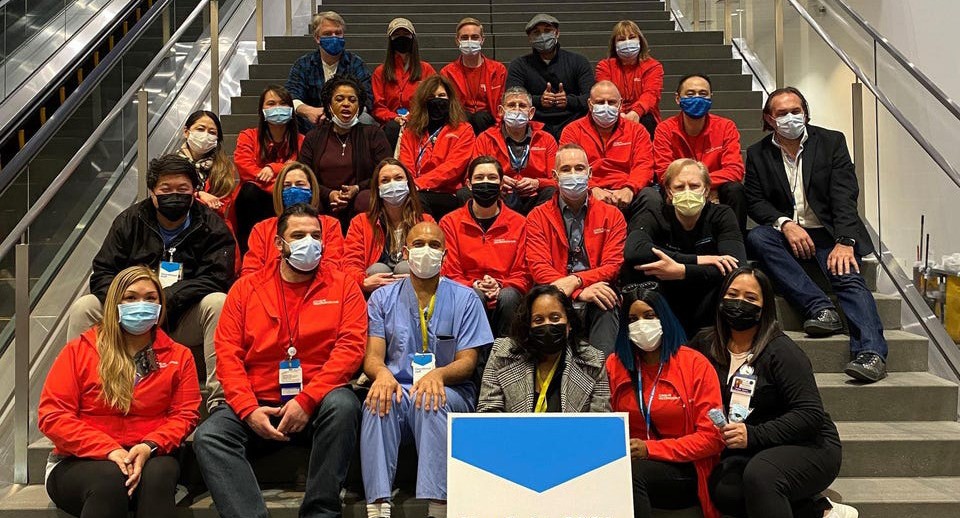
Futuro Health also supported the California Vaccination Campaign effort as part of a consortium of health organizations during the COVID-19 pandemic. In addition to Futuro Health, the consortium consisted of Kaiser Permanente, Adventist Health, CommonSpirit Health, American Red Cross, California Primary Care Association, and California Medical Association. For the campaign, the consortium organized 11 vaccination supersites with the goal of administering 10,000 vaccinations per day across all sites. Kaiser Permanente chairman and CEO Greg A. Adams stated, “We have helped form this consortium because our respective organizations recognize that we need to harness our collective efforts to make immediate and meaningful progress toward mass vaccination.”
To support this vaccination effort, Futuro Health conducted outreach to higher education institutions with nursing and allied health programs to invite their participation, and three colleges participated—College of San Mateo, Unitek College, and Quest Nursing. In addition to providing the vaccination campaign with needed personnel, Futuro Health also provided direct patient care opportunities for students. Ton-Quinlivan stated, “This mass vaccination creates opportunity for students to help out and engage in direct patient care, gaining clinical hours required for licensure which has been so difficult to obtain during the pandemic. We need to ensure we have the next generation of workers to deliver care.”
Futuro Health’s involvement in the campaign finished as of April 26, 2021, and over the course of their involvement, Futuro Health provided 4,350 shifts of workers to the Moscone Center vaccination site in San Francisco. In all, 387 individuals affiliated with Futuro Health staffed the vaccination site, including 100 licensed staff, 14 instructors, 7 shift managers, and 266 students. Students worked an estimated 25,500 hours across various roles, including vaccinators, vaccine instructors, shift managers, and students. Students earned an estimated 7,500 clinical hours toward their graduation and licensure requirements. As students worked at no-cost, the collaboration saved the vaccination campaign an estimated $757,500, which would have been the cost had the care been provided by licensed personnel. One student who worked at Moscone shared, “This clinical experience has made me feel like I have finally entered the clinical learning environment where I [began] to experience the way multiple disciplines work together to care for patients.”
Partnerships
 In addition to its partnerships with Kaiser Permanente and SEIU- UHW, Futuro Health has a number of other partners in the higher education and workforce development sectors. These include the Education Fund, Western Governors University, Voxy, Bay Area Medical Academy, Pima Medical Institute, Santa Barbara City College, MTI College, InsideTrack, Concorde Career Colleges, Inc., North-West College, and Merced College. Through Futuro Health’s partnership with the Education Fund, SEIU-UHW members who meet specific eligibility requirements can take advantage of a number of Futuro Health services and programs at no cost, including the Medical Assistant Program. In August 2020, Futuro Health joined Rework America Alliance, a new nationwide collaboration formed by the Markle Foundation that works to enable unemployed and low-wage workers to emerge from the COVID-19 pandemic stronger by connecting them with career advancement opportunities that are aligned with employer needs. CommonSpirit Health partnered with Futuro Health to build its health IT workforce.
Futuro Health’s partnerships have been an integral part of its success, allowing it to create programs that best align with their goals and also meet the needs of the healthcare industry. When seeking and establishing partnerships, Futuro Health draws upon a variety of higher education institutions in the local Bay Area region, across the state of California, and across the country, as local institutions may not have the capacity or interest. “If institutions don’t have what you need, then you need to shop around,” stated Ton-Quinlivan.
Lessons Learned & Takeaways
Take a collaborative, multi-sector, ecosystem approach to address workforce development challenges in the healthcare industry.
Futuro Health’s collaborative, multi-sector, ecosystem approach to solving workforce development challenges in the healthcare sector provides the program with agility and creativity. First, this approach makes it easier for employers to engage with higher education partners and other healthcare employers, which they are often disconnected from or compete with. This increased engagement allows higher education partners to innovate faster and better adapt to and meet industry needs. For instance, during the COVID-19 pandemic, Futuro Health was able to rapidly respond to the shifting needs of the healthcare industry by launching two pandemic readiness courses and participating in the California Vaccination Campaign to provide needed personnel for the campaign as well as clinical opportunities for students. In addition, this approach breeds goodwill from the community and allows for scalability of Futuro Health programs.
Partner with higher education and workforce development organizations across the country to meet program needs and increase capacity and equity.
Futuro Health’s partnerships have played a pivotal role in the program’s success by allowing the organization to create programs that meet the needs of the healthcare industry and that best align with Futuro Health’s goals and the candidate pool. For instance, their partner InsideTrack helps students enroll in programs, thereby promoting equity and inclusion for candidates with barriers to enrollment. When selecting partners, Futuro Health considers partners from a range of geographic locations, focusing on those that can best meet their needs rather than limiting them to those in close geographic proximity. The locations of their higher education partners range from the local Bay Area, throughout the state of California, and across the country.
Provide students with wraparound support services to promote opportunities for equity and inclusion.
Futuro Health provides students with wraparound support services to help them with enrollment, career exploration, education financing, attaining credential or licensure, and finding and transitioning into healthcare positions. For instance, its partner InsideTrack helps students enroll in programs, its partner Voxy helps Spanish speaking students develop career-based English skills, and SEIU-UHW took the lead to scout and recruit applicants to become Futuro Health Scholars. By supporting students with barriers to enrolling in and successfully completing its programs, Futuro Health promotes a workforce that is more culturally competent and promotes equity and inclusion.
Use data to measure and increase the impact of programs.
A central part of Futuro Health’s strategy has been to use data to measure and increase the impact of its programs. Futuro Health’s chief data scientist uses data to assess what intervention works best, for whom interventions work best for, and how and why interventions are effective. Additionally, the program uses data to connect potential and current students with nearby educational and employment opportunities.
We sourced 68 candidates—with 80 percent diversity. 64 gained admittance into the Pharmacy Tech Program offered by our education partner. Normally, their students complete at a 75 percent rate. Our Futuro Health Scholars came in at 96 percent!
Van Ton-Quinlivan, CEO of Futuro Health.
- “California Health Organizations Stage Mass Vaccination Hubs,” Kaiser Permanente, February 4, 2021
https://www.prnewswire.com/news-releases/ california-health-organizations-stage-mass-vaccination-hubs-301222658.html - “California Vaccination Campaign,” Futuro Health, accessed June 8, 2021,
https://vaccination.futurohealth.org/ - Celina Shands & Van Ton-Quinlivan, interview by Debbi Perkul, Lauren Worth, & Sophie Hearn, January 8, 2021.
- “Futuro Health Offers Pandemic-readiness Training to California’s Licensed Vocational Nurses for Anticipated COVID-19 Surge,” Futuro Health, April 8, 2020
https://futurohealth.org/wp-content/uploads/2020/04/ Press-Release-Pandemic-FINAL-1.pdf. - “Futuro Health Enrolling 1000+ in Medical Assistant Programs,” Futuro Health, May 26, 2020
https://futurohealth.org/wp-content/uploads/2020/06/ eConnection-5-20-20.html - “Futuro Health Recruiting 1,000 Spanish Speakers for Tuition-Free English Language Course for Healthcare Industry Jobs,” Futuro Health, July 28, 2020
https://futurohealth.org/wp-content/uploads/2020/07/English- Readiness-Press-Release_FINAL.pdf - Futuro Health 2021 Annual Report (Sacramento, CA: Futuro Health, 2021), page 3
https://futurohealth.org/wp-content/uploads/pdf/FH-2021-Report.pdf - “Growing the Largest Network of Healthcare Workers,” Futuro Health, accessed June 8, 2021
https://futurohealth.org/about/overview/ - John Vu & Van Ton-Quinlivan, “Creating Inclusive Opportunity,” Healthcare Anchor Network. June 10, 2021.
- “New Nonprofit to Address Health Care Worker Shortage,” Kaiser Permanente, January 8, 2020
https://about.kaiserpermanente.org/our-story/ news/announcements/Nonprofit-to-address-health-care-worker-shortage - Ted Anderson, “Kaiser Teams with Health Union in $130 Million Venture to Combat Worker Shortage,” San Francisco Business Times, January 8, 2020
https://www.bizjournals.com/sanfrancisco/news/2020/01/08/kaiser-teams- with-health-union-in-130.html - Van Ton-Quinlivan, e-mail message to Lauren Worth & Sophie Hearn, June 6, 2021.
- Van Ton-Quinlivan, e-mail message to Lauren Worth, November 2, 2022.