
 | Goals
Key Strategies
Impact
|
Overview and Background
Based in Cleveland, Ohio, University Hospitals (UH) employs over 27,000 non-physician employees and focuses its inclusive, local hiring and workforce development initiatives on building intentional pipelines that connect community residents to first jobs, and then to career advancement opportunities within the institution.
UH’s inclusive, local hiring and workforce development strategy includes two types of initiatives. Outside-in programs are external facing, intentional programs that source candidates from specific, high-poverty neighborhoods. Inside-up programs are for current UH employees, connecting them to career development and advancement opportunities.
UH’s talent acquisition team has worked in tandem with a variety of community partners to identify and recruit applicants from neighborhoods near the main hospital campus that face socio- economic challenges. Once connected with the potential recruits, a workforce development organization uses a co-developed work-readiness program to help individuals learn how to set themselves up for success in the application process. UH sets aside a certain number of open positions and interviews from an applicant pool composed of graduates from this readiness program.
UH’s inside-up programs include a robust set of literacy building and skills training initiatives, with built-in supports such as release time, and partnerships with education and training entities that can provide targeted skills development. Release time enables employees to participate in trainings during paid time while maintaining their full-time wage and benefits These earn-and-learn and apprenticeship programs provide opportunities for incumbent employees to receive paid, job- specific training to move into more advanced positions on the career ladder.
Program Design
UH’s outside-in programs
In 2013, University Hospitals started the Step Up to UH program to support economic development in high poverty neighborhoods surrounding the main hospital campus by training residents to fill open positions at the institution. Prior to starting the program, UH had two major barriers to increasing local hiring: a large number of applications received by UH (over 17,000 a month), which prevented many local residents from gaining the attention of the recruiters, and high turnover rates for specific positions. This necessitated a different recruitment approach for local hires. Kim Shelnick, UH’s vice president of talent acquisition, developed a new “funnel before the funnel” technique in which UH community partners would conduct the initial screening and training of neighborhood applicants. These local residents’ applications would then be considered as a separate pool by target departments.
Since that time, UH’s talent acquisition team has worked in partnership with a variety of organizations, including community-based organizations, workforce intermediaries, and a community college, to identify and recruit local hires, and has developed an employer customized job-readiness program that is delivered by their non-profit workforce development partner, Towards Employment. Once connected with the potential recruits, UH’s team uses Towards Employment’s readiness program to help potential applicants learn how to set themselves up for success in the application process.
In 2020, UH shared the Step Up to UH model with their regional Healthcare Sector Partnership (which also includes Cleveland Clinic and The MetroHealth System), and co-branded the program as the Career On-Ramp initiative. As of January 2023, UH has hired more than 420 individuals through Step Up to UH and the Career On-Ramp initiative.

Robert began working in UH’s Dietary department in 2011 and participated in several incumbent training and workforce development programs, leading to promotions to roles in Patient Access and Human Resources. Today, he’s a Talent Acquisition Coordinator.
UH’s inside-up programs
In addition, UH has built several inside-up programs to address critical workforce needs in a changing market that create career advancement opportunities for incumbent employees. Some of these programs are also available to community members who are not yet employees of UH. Earn-and- learns, apprenticeships, and other paid training programs that are open to both current employees and members of the community provide opportunities to receive paid training that results in either a new job for a community member or a promotion for a current employee. For example, a Professional Pathway program provides training for administrative support positions. Over the course of eleven weeks, employees participate in paid training in hard and soft skills during the day, work at the hospital at night, and upon completion of the program, obtain positions in Patient Access, Revenue Cycle and as Unit Secretaries.
By utilizing an innovative “advance hire model,” recruiters can fill positions that are currently available while UH’s workforce development staff prepare individuals to fill roles that will become open later. Shelnick explains that, while there are risks associated with hiring someone before they’re ready for a specific role, “I think it’s worth the risk because turnover is increasing at such a rapid rate in healthcare.” Given market trends and demographic shifts, adds Shelnick, “the days of ‘right fit, right role’ candidates that are job ready…those days will end.”
Some other recently developed inside-up programs include new apprenticeship programs for Pharmacy Technicians, Community Health Workers, Medical Assistants, and a Patient Care Nursing Assistant (PCNA) to Licensed Practical Nurse (LPN) Apprenticeship. These are unregistered, earn-to-learn apprenticeships, where participants are paid to learn new skills while on the job. While program design varies based on the training and educational requirements, apprenticeships might include a mix of classroom-based instruction, practicums, and study halls. Roles that require technical certifications are typically one year or less in length, while roles that require an associate’s degree require additional time. A design goal is to reduce as many barriers as possible for participants to study, for example by intentionally building in study time throughout the week.
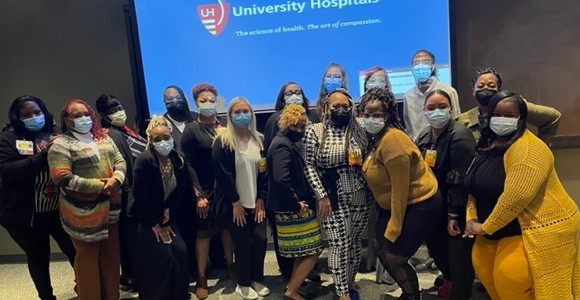
Graduates of Step Up to UH.
As of 2020, 97 hires have been made through the Pharmacy Technician Apprenticeship, 28 through the Community Health Worker Apprenticeship, and 84 through the Medical Assistant Apprenticeship.
In an interview, Cleveland resident Lisa Pointer described applying to a role at UH and being turned down because she “didn’t have the right keywords in [her] resumé.” She began participating in the Healthcare Sector Partnership Career On-Ramp Program, which would lead to a PCNA role upon completion. Program administrators then interviewed Pointer about her skills and interests and suggested she transition to UH’s community health worker (CHW) apprenticeship program, which would be a better match for her skills and interests. The paid CHW training took place during work hours, which Pointer noted was “great for me as someone who needs childcare.” She described how throughout the process, “there were continuous touchpoints from the people running the program to ensure that it’s the right role for you, making sure you’re doing self-care, not feeling burnt out, and getting positive messaging.” Today, Pointer is a successful Certified Community Health Worker.
A highly successful element of UH’s strategy for advancing entry-level employees is the addition of a full-time career pathway coach. Career coaching is available to all employees to support their progression along a career pathway, as well as to help increase UH’s internal hiring rate. Career pathway coaches help employees navigate various options for advancement within the institution and the training opportunities offered, including pathway programs as well as college education.
Shelnick describes career pathway coaching as an “invaluable and worthwhile” strategy for retention, as coaches are able to build trusting relationships with employees and provide guidance around their options for navigating careers in healthcare. By meeting with employees on their own terms—for example, in their department, the Employee Enrichment Center, the cafeteria, or even offsite at libraries and restaurants—the coach is able to build trust with employees, thus enabling them to feel more comfortable speaking honestly about challenges such as housing or transportation. The coach then works with the employee to connect them with institutional resources or social services that may not otherwise be easily accessible.
In 2021, more than 1,200 employees came into contact with UH’s full-time career pathway coach, 199 employees received individual coaching support, 23 employees who received coaching support were promoted into higher skill positions. A total of 61 employees transferred to higher skill positions or lateral positions with greater career ladder opportunities. The average retention rate of employees who received coaching support was 86%.
In addition to implementing pathway programs and providing coaching support, UH trains managers and supervisors to better support employees in entry-level positions. Shelnick explained, “[We’re] training our leaders on how to be more understanding of the everyday problems that this level of employee is experiencing from social and economic standpoints…If they’re having a babysitter problem, or just having other day-to-day problems as single moms or dads, we can give training to our leaders to know how to work through those issues.”
Program Impact
STEP UP TO UH AND CAREER ON-RAMP INITIATIVE:
- 420 hires since 2013
- Reduced interview to hire ratio for recruiters
- One-year retention rate at 88% for pipeline graduates, compared with 72% overall
POSITIONS GRADUATES ARE HIRED INTO:
- Environmental services
- Nutrition services
- Patient care assistant
CAREER PATHWAY PROGRAMS OPEN TO INCUMBENTS INCLUDE:
- Pharm Tech Apprenticeship - 97 hires since 2020
- Community Health Worker Apprenticeship – 28 hires since 2020
- Medical Assistant Apprenticeship – 84 hires since 2022
- Licensed Practical Nurse Apprenticeship – 16 hires since 2022
Funding
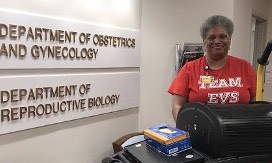
Since joining UH as an Environmental Service Worker, Rhonda has participated in several pathway programs and has been promoted three times. She is now a Revenue Cycle Specialist.
UH’s inclusive, local hiring initiative was originally supported with significant grant funding and community-based support. Over time, as the initiative became established at UH, funding sources shifted to utilizing internal resources. Other costs, such as training and outreach for the Career On-Ramp program, are funded by braiding internal resources with community partners’ funding.
Apprenticeships are funded through a combination of internal funding, tuition assistance dollars, employer training reimbursements available through the county, and training provider grants that cover aspects of program implementation.
Shelnick advised that when budgeting for earn-and-learn programs, there should be a broad understanding that employees will be contributing part-time productivity during the training period even though they will receive full-time wages.
Staffing
Shelnick emphasized the importance of investing in workforce development infrastructure internally given the returns on increased retention. UH’s inclusive, local hiring and workforce development programming is staffed by an FTE manager of workforce development, an FTE career coach, an FTE program specialist, and supported by a Diversity, Equity, and Inclusion, Social Justice and Equity team. Recruiters in functional areas of the pipeline programs have partial FTEs devoted to pipeline program recruitment. In addition, UH trains hiring managers and department educators to manage the apprenticeship programs.
Partners
Towards Employment, UH’s external workforce development partner, provides grassroots recruitment and screening, job readiness training, coaching, soft skills training, and curriculum development. In addition, UH works with the workforce arms of educational institutions such as the local community college, NewBridge Cleveland, and OhioMeansJobs (the public workforce system in Ohio).
Lessons Learned and Takeaways
Earn-and-learns and apprenticeship programs are an investment in a sustainable talent pipeline. “With a shortage of candidates, we have to rethink traditional policies,” says Shelnick. “[Sometimes] you can’t wait two weeks to hire someone.” Through paid training programs, she says, “[you can support] some people and help them to adapt [to new roles], but recognize that some will turn over and return to the local workforce development ecosystem.”
Kim Shelnick, UH’s vice president of talent acquisition, developed a new “funnel before the funnel” technique, in which UH community partners would conduct the initial screening and training of neighborhood applicants, who would then apply to job openings in target departments as part of a separate pool.
From nicety to necessity: be nimble and grow with the initiative
As an initiative gets older it shifts from a nicety to a necessity as the system becomes reliant on it as a crucial hiring stream. As this shift occurs the needs and abilities grow and change, so the system must be flexible and adapt appropriately. Over time, UH has evolved its pipeline programs and expanded its portfolio of paid career advancement programs in order to fill critical roles and meet market demands.
Geographic focus on high-poverty neighborhoods
Prioritize specific neighborhoods and people who might not be able to successfully apply to these jobs through the regular recruitment process. As the inclusive, local hiring program grows, the focus for recruitment can be expanded to include additional local communities.
Set aside positions for pipeline cohort graduates
This process ensures that program candidates do not get lost in the large volume of applications for open positions.
Offer job coaching for new hires and map out potential career pathways
Outline clear pathways for entry-level employees to advance to higher-wage positions by mapping out training opportunities that will allow employees to learn new skills. This helps employees identify career opportunities and promotes increased retention, and can also help to meet system diversity goals by creating intentional pathways through which employees of color in entry-level roles can rise into higher level positions.
Tuition assistance for entry-level employees to access training
When possible, allow employees to get release time, which enables employees to participate in trainings during paid hours while maintaining their full-time wage and benefits. Have human resources connect employees to tuition assistance for both degree granting programs and for skill building and certificate programs. UH offers both tuition reimbursement and deferred direct billing.
Regularly re-evaluate partnerships
Re-evaluate partnerships with regularity to determine if the needs of the initiative are being met by the partnership. When establishing partnerships ensure partners are willing to adjust the partnership or the deliverables to grow with the needs of the initiative.
- Kim Shelnick, interview by Debbi Perkul and Lauren Worth, August 24, 2022.
- Adrianne Shadd and Kim Shelnick, interview by Debbi Perkul and Lauren Worth, January 21, 2022.
- Lisa Lennette Pointer, interview by Debbi Perkul, June 9, 2022.
- Adrianne Shadd and Kim Shelnick, interview by Debbi Perkul and Lauren Worth, January 6, 2023.
Video overview of the UH Pharmacy Technician Training Program