
Offer Job Coaching and Map Out Potential Career Pathways
Providing entry-level workers with job coaching is an important first step in setting them up on a pathway to advancement. Just as the initial application process can be a barrier for candidates, navigating the many departments within a health system can also be a challenge for employees, especially if they are interested in applying to a new job category. Coaches can help bring to light possible pathways and connect employees to individuals already working in areas of interest for informational interviews, job shadowing, and mentoring. They can also identify critical skills gaps and help employees find opportunities for getting necessary training. Ultimately, career coaches support employee retention by allowing employees to navigate new career opportunities within the health system.
An inside-up strategy demonstrates to the employees that the health system is invested in them as people and wants to help them reach their full potential. Job coaching is a way to show employees what's possible as they navigate to new career opportunities within the health system with the help of the coach. For example, at Ochsner Health in Louisiana, entry-level employees are connected to a career coach who works with them to identify strengths and areas for growth, map out a career pathway, and navigate training programs, tuition assistance, and other benefits that could help them to grow in the organization.
Career Navigators can provide targeted support to employees in specific roles, for example, those hired through outside-in programs. This is the case with Trinity Health’s R.I.S.E. Up (Reach out, Investigate, Seek, Elevate) program, which provides career navigation and wraparound services to medical assistants, patient care assistants, pharmacy technicians, and employees with roles in phlebotomy and environmental and nutritional services. R.I.S.E. Up includes an outside-in, career readiness training component that connects local job seekers to career navigation support provided by the local workforce development board. These individuals are then supported through the process of applying for and interviewing for jobs at the health system. With the navigation support for incumbent employees, one goal is to support the promotion of employees in specific job categories of focus each year. Since the inception of this program, they have intentionally scaled it across the system expanding its reach, standardizing implementation and driving measurable impact system wide. What began as a focused initiative has evolved into a fully integrated, system wide strategy aligned with their organizational priorities and long-term workforce goals.
Coaching models
Coaches can be contracted through a workforce intermediary (such as the organization that provided the initial training in the pathway program) or can be hired on as staff at the health system. One benefit of contracting with coaches employed through intermediaries is that they are often connected to other wraparound support organizations and have expertise in soft skills support. Job coaches hired on as staff are often more knowledgeable of employment needs within the hospital and are familiar with the positions—therefore they can be more effective in connecting employees to new opportunities. This approach can be helpful in filling positions quickly and ensuring employee success.
Advocate Health developed a Teammate Success Coaching (TMSC) program to support departments and sites with high turnover rates, particularly among new hires, entry-level teammates, and those hired through the organization’s Returning Citizens Initiative. Internal success coaches work with teammates to identify barriers to retention and then connect them to resources for immediate support. This could include grocery or cafeteria vouchers, bus or rail passes, a personal hygiene care package, a voucher for emergency backup childcare, or uniform clothing (through a partnership with Goodwill). From there, coaches connect one-on-one with teammates to discuss goals, provide personal and professional guidance, and share referrals for long-term support, including financial wellness coaching. The program also facilitates essential skill-building and career exploration for participants.
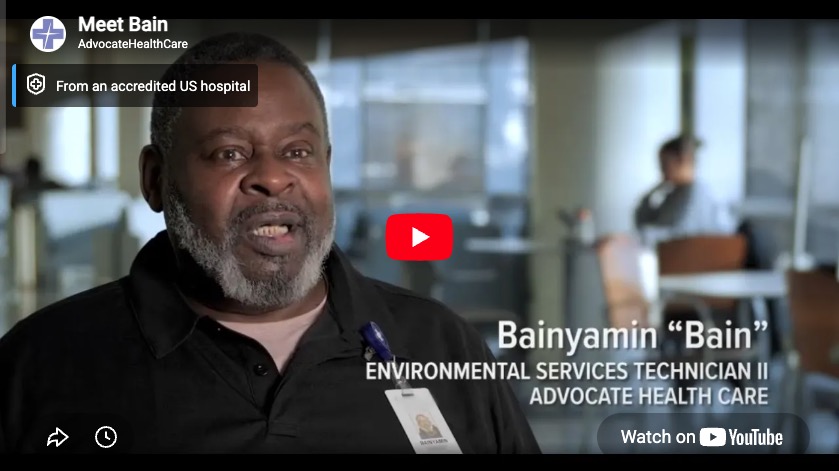
To date, 311 teammates have received coaching support, with 178 (57%) receiving assistance around food, transportation, and clothing, averaging 45 requests per month.63 Bainyamin, a Technician II in Environmental Services, who goes by “Bain,” is a successful graduate of the TMSC program. Bain was previously unhoused and faced significant challenges entering his new role at Advocate Health, including high levels of stress and a four-hour daily commute from a housing shelter. Bain received immediate support, including a 30-day transit pass, cafeteria vouchers, access to a food pantry, a hygiene care package, and essential items such as shoes and a belt. Bain’s success coach connected with him more than 50 times in his first three months of employment, providing encouragement and addressing needs as they came up. For long-term support, Bain was referred to an Employee Assistance Program for stress management and a financial coach to help with budget planning. Bain’s accomplishments include celebrating two years at Advocate Health, improved self-care and wellbeing, perfect attendance to date, and securing stable housing close to work.
Provide Tuition Assistance and Advancement to Entry-level Employees
An essential strategy for ensuring that inside-up initiatives lead to career advancement is to ensure that tuition assistance is accessible to entry-level employees. Some health systems have policies whereby only degree-granting programs are eligible for tuition assistance and short-term technical certificates are not eligible. The term “certification” may cause confusion, as short-term technical training programs that ensure a person has the necessary skills to perform a job, such as a pharmacy technician or phlebotomist, use the term certification in a different way than professional enhancement certifications such as a Lean certification, a program management certification, or a Human Resource SHRM certification. Being able to explain the difference to internal leaders who create tuition assistance policy will be important to affecting change.
Writing policies regarding tuition assistance eligibility without the full understanding of the word “certificate” may have the unintended consequence of eliminating the pursuit of important technical certificates by those who would most likely engage in this training—entry-level employees—even though these employees may gain the most from financial support.64 Therefore, tuition assistance should be made available for certification programs that include occupations such as medical coding, patient care, surgery technician, and phlebotomy. Other courses that could be considered for tuition assistance eligibility that would benefit entry-level employees include English for Speakers of Other Languages (ESOL), literacy and numeracy, college preparation, and paths to citizenship.
It is crucial that institutions communicate clearly to entry-level workers about the availability of education and training opportunities. One strategy employed by Baystate Health is to host in-person “opportunity fairs” where employees, especially those with limited access to computers, can learn about the benefits and programs available to them that can help to build financial security, including financial assistance for education.65 In addition, it is important that employees become eligible for internal training programs within a reasonable timeframe. Workforce planners can also help connect new employees to tuition support opportunities. Even if employees are not yet eligible for tuition assistance until after three months of employment, for example, they can begin working with a workforce planner early on, who can help them assess their skills and identify trainings they might be interested in for when they do reach the tenure requirement to qualify for this benefit.
Since the upfront cost of college degrees or technical training programs can be a barrier to participation for entry-level workers, as many cost hundreds or even thousands of dollars, tuition advancement and direct payment for education help make these programs more accessible. Hospitals that provide tuition advancement often ask employees to sign agreements stating that they will work at the institution for a designated period of time after completing the training, and that they will complete the degree program. These accountability measures allow institutions to more clearly trace the impact of what are often costly tuition programs. Other measures include requiring back payments if the employee does not finish or pass the program. With agreements such as these, it is critical that job coaching and academic support be provided to troubleshoot problems as they arise in order to improve completion rates.
Ascension has taken this approach, providing debt-free education to employees who seek to pursue certain clinical pathways. Through the health system’s Vocare program, tuition is paid directly to the partnering education institutions so that employees face no out-of-pocket costs. “The Vocare Program has granted me the freedom to pursue a career I am passionate about without the financial burden,” reflected Renata, an employee studying to become a surgical technologist. “I am grateful it has created an opportunity for learning and growth within a space that recognizes my unique needs as a full-time employee and student.”66
The Johns Hopkins University and Health System works with their vendor Guild to help employees fund degree programs as well as access tuition-free learning opportunities with the myTuition education benefit program.
An example of adapting tuition payment to help facilitate participation can be found at University of Vermont Health (UVM Health), which enables employees to earn wages and benefits while pursuing advanced studies to further their career—often with full tuition support. Facing a shortage of nurses in its rural setting, the health system developed a nurse education pathway program to remove barriers for individuals seeking to enter or advance in the nursing field, with grant support for tuition advancement from the Vermont Agency of Human Services. Launched in 2023, the program covers the tuition, fees, and books for 25 individuals pursuing a master’s in nursing education. “We [previously] had traditional tuition reimbursement, which is limited,” explains Betsy Hassan, director of nursing education and professional development. “The finances of going back for a graduate degree are hard for many.”67
In order to access tuition advancement, individuals are asked to commit to a two-year, dual work-service agreement that includes working with UVM Health and teaching with a partnering college of nursing. “The candidates who came forward [for the nurse education pathway program] were people who already wanted this career and were thinking about doing it at some point,” says Hassan. With tuition advancement, they can meet their career goals, while UVM Health is able to prepare additional employees to progress into nursing roles. For example, individuals with little to no prior experience can go through a Licensed Nursing Assistant (LNA) earn-and-learn program, and at a later point, participate in an LNA-to-RN Pathway Program with tuition advancement.
Xi Chen, a newcomer to Vermont with limited English proficiency, started at UVM Health as a hospital cleaner and participated in an English language training program, leading to a LNA certification. She has since obtained her practical nursing certificate and is now training to become a registered nurse through a local university partnership. Xi is receiving tuition support through an employer-funded loan program called the Workforce Opportunity Loan Program (WOLP). UVM Medical Center and UVM Health provide the funds and repay the loan payments as Xi continues through the program and the first three years of employment as a registered nurse, fully funding her education. Xi has stated that she has “a strong desire and a calling to be a caregiver, [and] I’m able to do that and provide for myself because of the support I get from our leaders and my coworkers.”68
Provide Earn-and-learn Education Opportunities and On-site Training
While tuition assistance might make training programs financially accessible, there can still be major barriers for participation, especially for low-income workers. Individuals might have multiple jobs or may not have access to reliable transportation. Providing on-site training opportunities can help facilitate participation by reducing commute time and making it easier for employees to attend. Moreover, if the training has a clinical component, employees become familiar with institution-specific equipment and facilities.
The University of Utah Health’s on-site Workforce Development Center connects residents with resources and tools for job searching, resume building, and interview preparation, and provides internal career development services such as internal career fairs and career development courses for employees. Resources are available online through an enhanced website, which includes tools to support career advancement, job searching, and resume development. A workforce development counselor is available for one-on-one consultations to support career advancement, providing overviews of career pathways and guidance on the requirements for each role. Internal programs include pharmacy technician, medical assisting for radiology specialties, nurse residency, critical care, and operating room internships. In addition, the workforce development counselor acts as a liaison between the university and partner organizations that support career pathway programs for roles in surgical technology, sterile processing, and radiation therapy. By being located on-site, the Workforce Development Center is better positioned to deliver on its goals of increasing job growth, investing in employees, improving retention, and enhancing employee satisfaction. 68c
Another way to facilitate participation in training programs is to provide release time for employees so that they can complete training during work hours and thus maintain their full-time wage and benefits. In this case, the employee’s department may cover the wages, especially when the employee is being trained to move into a high-need position within that department. Other models include having wages covered by the department where the newly trained employee will work once their training is complete, or utilizing grant funds that pay wages.
Partner with Local Education Institutions and Community Organizations
Universities, community colleges, and technical schools are critical partners in developing worker-training programs. Often, these partners have the relevant expertise and have developed the necessary curriculum to run training programs, or they are in good positions to develop specific programs if there is enough demand.
An example of a successful education partnership is the creation of a Licensed Practice Nurse (LPN) program at Central Valley Medical Center in Nephi, Utah. In the early 2000s, the rural hospital faced a nursing shortage, and had difficulty hiring LPNs. To address the shortage, leadership from the hospital and a local community college, Snow College, came together and created the LPN program. The community college is located 40 miles from the hospital, but the classes are offered on-site and instructors from the community college tele-teach, using virtual classroom technology. Central Valley provides the classroom space and coordinates the clinical rotation component of the course. Through this partnership, Central Valley trains and recruits LPNs, and Snow College offers students training connected to local employment opportunities. Partnerships such as these benefit both the health system and the educational partner. In these partnerships, the health system can provide access to clinical space and on-site training—in-kind resources that are a necessary component of high-quality medical training.
The Dartmouth Health Career Institute partners with Colby-Sawyer College to design education programs that expand healthcare career opportunities and strengthen critical workforce pipelines. Participants in the Medical Assistant, Pharmacy Technician, and Surgical Technology apprenticeship programs are hired at the onset of training as full-time employees, earning a training wage and free college credits towards an Associate’s Degree in Health Science. After completing the programs, participants advance into the certified or licensed roles for which they trained.
Kaiser Permanente provided $130 million in funding to establish Futuro Health in 2019 in partnership with SEIU United Healthcare Workers West and contributed an additional $100 million in 2023 to further expand its impact. Futuro Health is a career-advancement intermediary organization that works collaboratively with higher education entities, healthcare institutions, and community organizations to place graduates into full-time employment as allied healthcare workers. Futuro Health’s education-to-work model was designed to support candidates through every stage—including enrollment, career exploration, education financing, coaching on pathways toward credential or licensure, and employment preparation. Since its launch in 2020, Futuro Health has had 10,025 scholars who pursued a personalized education journey to earn an in-demand healthcare credential and qualifications; 48% of the students are bilingual. 68a , 68b
63.
Bridgett Beene and Tanisha Isom, “Teammate Success Coaching (TMSC): Advancing employee financial stability and addressing barriers to retention” (Healthcare Anchor Network Convening, St. Louis, October 8, 2024).
64.
Dr. Cinda Herndon-King and Helen Slaven, interview by Katie Parker, Healthcare Anchor Network, February 24, 2016, transcript.
65.
Frank Robinson, “Employers Principles for Helping Employees Thrive,” (Impact Workforce Group Call, Healthcare Anchor Network, Webinar, October 8, 2024.)
66.
“Vocare Education Program: Providing debt-free career training for associates,” Ascension, accessed November 13, 2024, https://jobs.ascension.org/us/en/blogarticle/vocare-education-program-providing-debtfree-career-training-for-associates.
67.
Rebecca Aldrich, Jerry Baake, Betsy Hassan, “University of Vermont Health Network Center for Workforce Development,” (presentation, Healthcare Anchor Network, Impact Workforce Call, March 14, 2024).
68.
University of Vermont Health Network (Burlington Vermont: University of Vermont Health Network and National Fund for Workforce Solutions, n.d.), page #4, https://nationalfund.org/wp-content/uploads/2024/08/CareerSTAT_Champions_UVM_08.29.2024.pdf.
68a.
Kaiser Permanente & Futuro Health: Creating education journeys into allied health careers (Healthcare Anchor Network, 2023), page #4, https://healthcareanchor.network/2023/02/kaiser-permanentes-futuro-health/.
68b.
Jasmine Brar emailed Hue Phung and Lauren Worth updated impact numbers, Kaiser Permanente, September 25, 2025, Healthcare Anchor Network.
68c.
RyLee Curtis, email to Hue Phung and Lauren Worth, The University of Utah Health, August 6, 2025, Healthcare Anchor Network.